Recently I saw a few blog posts complaining about companies not fixing old bugs in products for decades, which immediately reminded me of a project management flaw I’ve noticed everywhere I’ve worked.
A picture is worth a thousand words, behold:
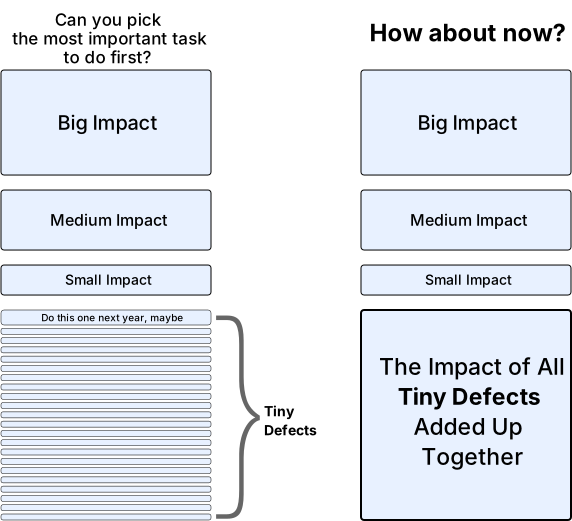
The current approach to prioritization in business is overwhelmingly dominated by the principle “do the few things that matter most and ignore the rest.” It appears in many slightly varying forms, taught by endless business, management, startup, time management lessons:
Do your most important task first.
Focus on high‑impact, high‑leverage activities.
Not all tasks have the same impact; spend time on the ones that move the needle.
Success isn’t about doing more; it’s about doing less of what doesn’t matter and more of what does.
Cut, delegate, or stop everything that doesn’t move the business forward.
Say no to anything that distracts from what is truly important.
All of that is for a reason, of course: because it works. Most of the time that is exactly what you need, especially when the project is just starting. But life is complicated and full of nuances. If the path to success were just brainless repetition of the same thing, everyone would be doing that. Sometimes, the button you’ve been pressing for years stops working.
Sometimes the devil hides inside your own tools and methods, in the perspective that you take and in how you choose to perceive your situation. Do you have one “dirty face” problem, or do you have 23 separate problems: no.1 a smudge, no.2 a scratch, …, no.23 a smear? Both of those are valid perspectives, just different ways to view the same situation, but if you fail to see the forest behind the trees, one of them may and will lead to a completely different action plan according to the principle above!
Wiping off a tiny smudge is never as impactful as getting a haircut or dressing up, and the same is true for the other 22, so what does that mean…do everything else first and then waltz with a dirty face because you had no time left for the tiny bits? This is essentially Paradox of the Heap applied to work prioritization: it is correct not to prioritize low impact “polishing” tasks because they don’t move the needle…until you accumulate enough of them to bury your product.
This is usually the case with mature products which have quite a history of previous versions. This is the case with Apple, which causes frustrated users to create websites like https://www.bugsappleloves.com to which I can relate fully as someone who reported a bug in Safari 13(!!!) years ago and still experiences it today. They are all very pretty products, but with more and more smudges every year. The heap grows, until one day users catch themselves thinking: is it time to start looking for a prettier face?
So glad I am typing this on a real keyboard and not swiping iPhone’s onscreen input, which currently gets every 1 word out of 3 wrong! This also has been going on for years.
Another observation is poor promotion incentives in the company, where accomplishing one bulky feature looks great on a promo doc, even if said feature is just bloat and customers ignore it, but accomplishing a hundred small improvements looks like merely a lot of small scope work, even if customers are almost sending flowers to thank you for doing all that. In our post-Agile era, where engineers typically propose or pick work on their own, to promote exclusively for large impact work items is to encourage people to ignore this problem entirely.
Whatever is the reason, I believe this problem deserves some serious attention. My experience is that mature products start degrading in customer satisfaction at some point in their lifetime, not because the company’s engineering somehow degraded (can’t be, they are often all the same people), but because the company somehow begins consistently preferring to deliver what is clearly not what customers would pick to do first.
And yes, I am very well aware many low-priority tasks on the backlog are just engineers obsessing about irrelevant nerdy bullshit. I am very well aware customers often ask for the fifth leg on their horse because in their imagination that makes a smoother ride. It may not be easy to recognize this problem, but no one said leading projects would be easy. Let that not distract you from my point.